> For the complete documentation index, see [llms.txt](https://docs.quicksync.me/llms.txt). Markdown versions of documentation pages are available by appending `.md` to page URLs; this page is available as [Markdown](https://docs.quicksync.me/stagex/q-and-a-interface/key-user-features.md).
# Key User Features
## Knowing your anonymous name
Once you enter a StageX session, you will get a random anonymous name with a random pixelated profile picture. In the "People" session in the activity bar, you will know your random username highlighted as (You)
For example, in the above example, my anonymous name in the session is Lynda where it shows (You) refering to the user in the session
## Posting a Question
Users can posts question anonymously and drive engagement by simply writing and posting the question directly inside the question box
{% hint style="info" %}
Questions are limited to 280 letter to keep the conversation effective
{% endhint %}
## Upvoting a question
Users have the right to upvote a question to help best questions rise to the top. Users can upvote by pressing the upvote arrow next to the posted question. The more upvotes the question gets, the higher the chance it will be featured. This will give the best questions a chance to be pinned by Moderators.
## Downvoting a question
Users have the right to downvote a question that they doesn't interest them or add overall value to the conversation or the purpose of the session. The more downvotes a question gets, the less visibility it get during the discussion. Users can downvote by pressing the upvote arrow next to the posted question.
{% hint style="warning" %}
Every user can either upvote or downvote once to a specific question
{% endhint %}
## Filtering questions
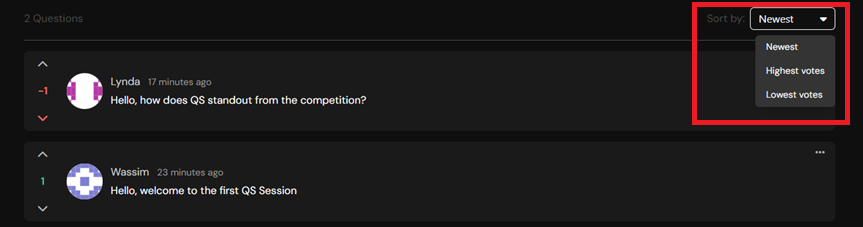
Users can sort all listed question based on their preference:
* Newest Questions
* Highest Voted
* Lowest Voted
## Deleting a question
Users can delete their own posted questions if they wish to. They can press on the three dots next to their accounts and press on "delete"
{% hint style="warning" %}
Users cannot delete other user questions, only the've ones they posted
{% endhint %}
## Navigating
The side activity bar is your go-to to get the best insights of the conversation. There you can see:
* Highest voted questions (Top 3)
* Pinned Questions from host or moderators
## Searching for users
Although users get random names, you can still search for a user within the search tab in the activity bar. This could be helpful if you've seen an active anonymous user and you wish to check all his questions
## Exiting the session
On the top left of the Q\&A interface, you'll see your profile picture. If you wish to exit the session, you can press on your profile picture and then press on "Exit Session" in the drop down menu
{% hint style="warning" %}
All your questions will be deleted if you decided to exit the session
{% endhint %}
{% hint style="warning" %}
If you directly closed your browser without pressing on "Exit Session", you will be automatically out of the session and your user will not exist
{% endhint %}
---
# Agent Instructions
This documentation is published with GitBook. GitBook is the documentation platform designed so that both humans and AI agents can read, navigate, and reason over technical content effectively. Learn more at gitbook.com.
## Querying This Documentation
If you need additional information that is not directly available in this page, you can query the documentation dynamically by asking a question.
Perform an HTTP GET request on the current page URL with the `ask` query parameter, and the optional `goal` query parameter:
```
GET https://docs.quicksync.me/stagex/q-and-a-interface/key-user-features.md?ask=&goal=
```
`ask` is the immediate question: it should be specific, self-contained, and written in natural language.
`goal` is optional and describes the broader end goal you are ultimately trying to accomplish on behalf of the user. GitBook uses it to tailor the answer towards what is most useful for that goal.
The response will contain a direct answer to the question and relevant excerpts and sources from the documentation.
Use this mechanism when the answer is not explicitly present in the current page, you need clarification or additional context, or you want to retrieve related documentation sections.